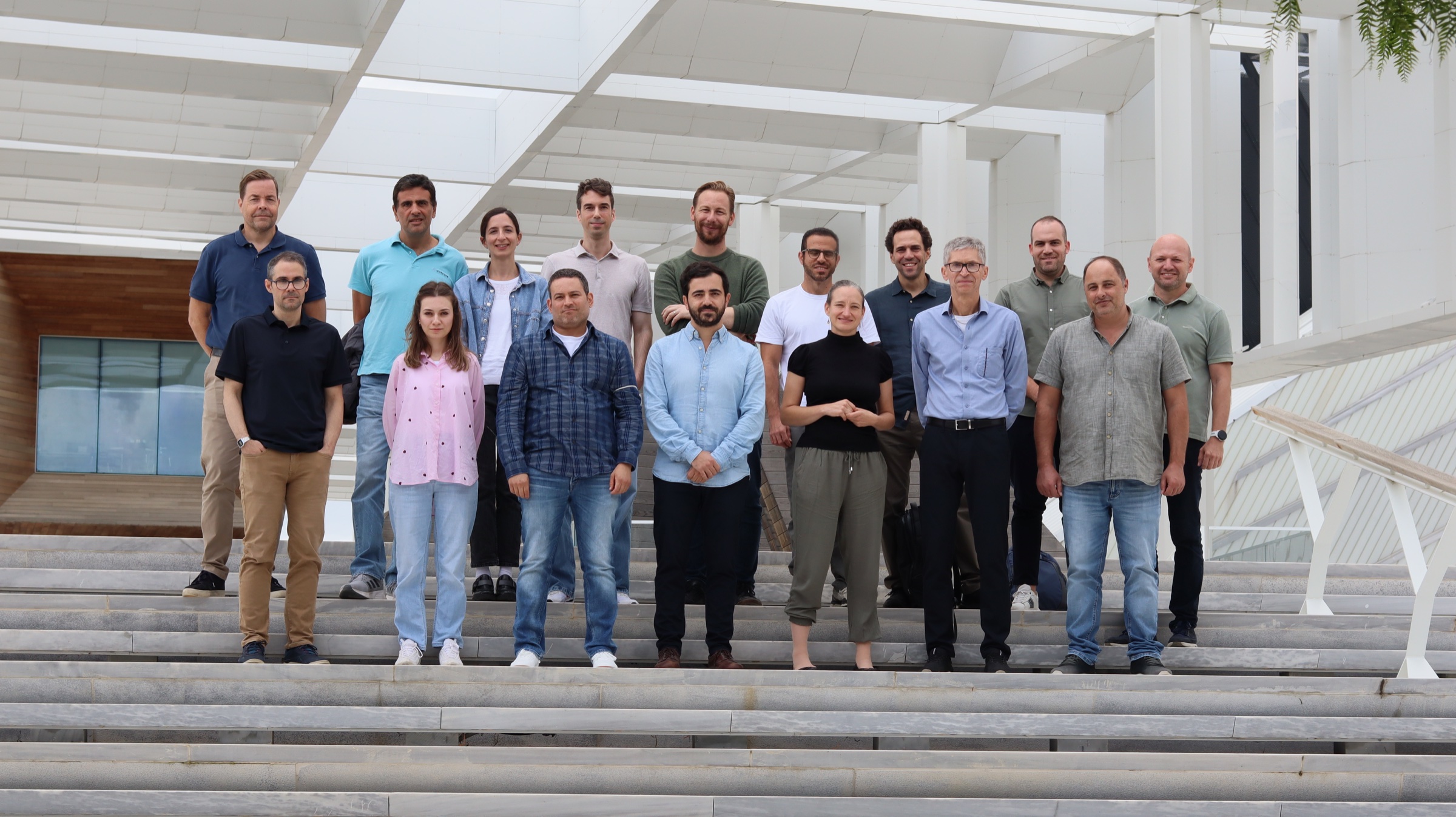
University of Cyprus Successfully Hosts WDCL 2026, Strengthening International Research and Academia-Industry Collaboration
NICOSIA, Cyprus – October 23, 2026 – The University of Cyprus successfully hosted the 2026 Workshop on Distributed Computing, Optimization and Learning (WDCL 2026) on October 14–16, 2026, bringing together leading international researchers, academics, and industry representatives for three days of scientific exchange and collaboration. Featuring participants from research institutions across Europe and beyond, alongside representatives from ABB Corporate Research (Sweden) and Sig.Network, the workshop highlighted the importance of international cooperation and academia-industry partnerships in advancing intelligent, interconnected, and autonomous systems. Building on previous editions in Paris (2024) and Munich (2025), WDCL 2026 further strengthened international research networks and created opportunities for future scientific and industrial collaborations.
International Organization and European Research Support
WDCL 2026 was jointly organized by Associate Professor Themistoklis Charalambous of the Department of Electrical and Computer Engineering at the University of Cyprus, together with Professor Derya Malak and Professor Petros Elia of EURECOM, France, who served as General Co-Chairs and Technical Program Co-Chairs.
This collaboration between the University of Cyprus and EURECOM reflected the international character of the workshop and its commitment to fostering scientific partnerships across institutions and national boundaries.
The workshop was supported by the University of Cyprus and two European Research Council (ERC) projects, MINERVA and SENSIBILITÉ, highlighting the role of European research funding in advancing scientific knowledge and strengthening international cooperation.
Advancing Research in Distributed Intelligence
As modern technological systems become increasingly interconnected, enabling multiple devices, intelligent agents, and computing units to cooperate, learn, and make decisions without relying on centralized coordination has become an important scientific and technological challenge. These developments are particularly relevant to autonomous vehicles, robotics, next-generation wireless networks, smart energy systems, and distributed artificial intelligence.
WDCL 2026 addressed these challenges through a broad scientific program covering distributed optimization, control and coordination; distributed and federated machine learning; privacy, security and trustworthy computation; information-theoretic foundations of learning; communication-efficient learning over wireless and edge networks; resilient distributed systems; coding and computation-communication trade-offs; and game theory, fairness and incentives in networked learning systems.
The three-day program featured two plenary presentations and ten invited talks, and contributed poster presentations, providing opportunities for participants to present recent findings, exchange ideas, and identify promising directions for future research.
Particular emphasis was placed on the interplay between computation, communication, learning, and control, demonstrating the importance of interdisciplinary approaches to the development of intelligent and autonomous technologies.
Bridging Academia and Industry
A notable feature of WDCL 2026 was the participation of ABB Corporate Research from Sweden and Sig.Network, bringing valuable industrial perspectives to the scientific discussions and reinforcing the importance of collaboration between academia and industry.
While academic research develops the theoretical foundations and innovative methodologies needed for intelligent and distributed systems, industry contributes practical experience, identifies real-world challenges, and helps guide technological development toward deployable solutions.
The interaction between academic researchers and industry representatives highlighted opportunities for joint research initiatives, knowledge transfer, technology validation, and innovation, particularly in areas such as industrial automation, intelligent communication networks, and cooperative autonomous systems.
These exchanges also offered early-career researchers valuable insights into the practical relevance of their work and opportunities to establish connections beyond academia.
Strengthening International Scientific Collaboration
Beyond its scientific program, WDCL 2026 provided an opportunity to strengthen existing international research partnerships and establish new connections among researchers from different institutions, countries, and scientific backgrounds.
The workshop's format, featuring plenary lectures, invited presentations, and poster sessions without parallel tracks, encouraged meaningful interactions between established academics, early-career researchers, and industry representatives. This environment fostered open discussion, constructive feedback, and the exploration of new research directions.
By hosting this international scientific event, the University of Cyprus reaffirmed its commitment to research excellence, internationalization, and collaboration with industry, while further strengthening its presence in emerging areas of engineering and information technologies.
The event also highlighted the University's contributions to distributed and networked systems, communication-aware optimization, cooperative autonomous systems, and intelligent wireless networks.
Looking Ahead
The successful completion of WDCL 2026 marks another milestone in the continued development of this international workshop series, demonstrating the value of bringing together researchers and industry representatives to address shared scientific and technological challenges.
The discussions and connections established in Nicosia are expected to contribute to ongoing research activities, encourage new international and interdisciplinary collaborations, and stimulate further advances in distributed computing, optimization, and learning.